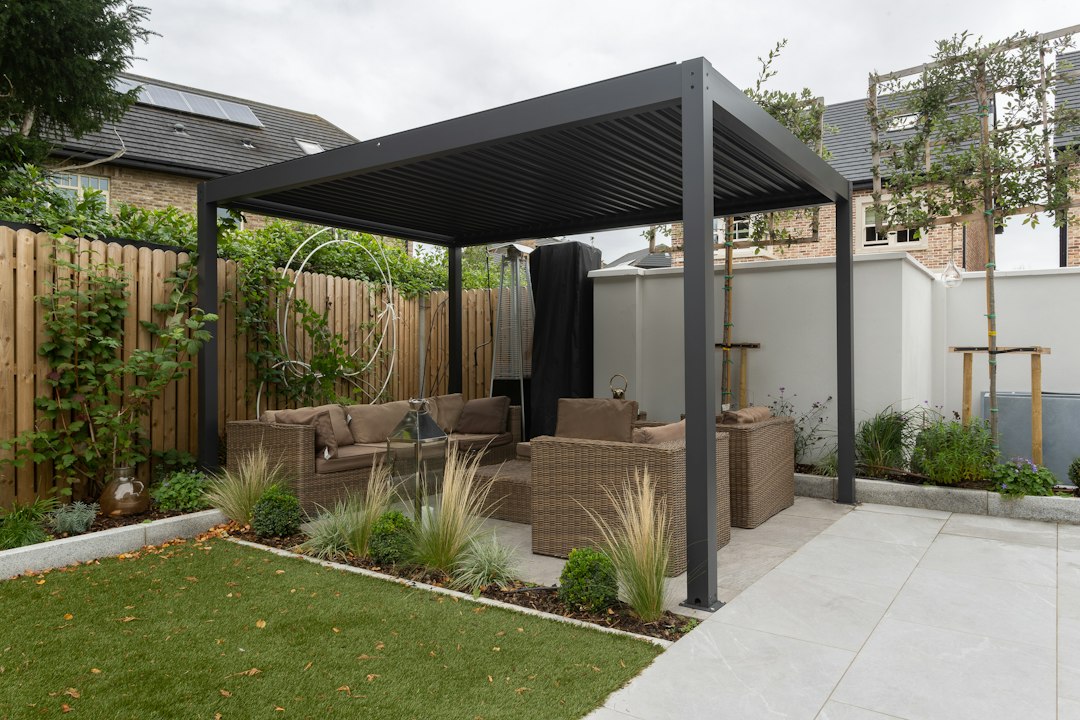

Roof design sets the character and day-to-day usefulness of the space. Fixed slats give partial shade and retain an open outlook, although their performance changes with the sun’s angle. Adjustable louvres are rotating blades that can open for daylight, tilt to reduce glare or close during a shower. A closed louvre roof should not be treated as a fully sealed conservatory roof. Rainwater still needs a controlled route away from the frame. Check whether gutters are concealed or visible, where downpipes sit and whether an outlet could leave a slippery area beside a doorway.
Orientation deserves a drawing rather than a quick glance from the patio. A south or west-facing terrace may receive low, strong sun late in the day, making side screening or adjustable shade useful. An east-facing seating area can warm quickly for breakfast but may need less roof coverage later. Hedges, walls and trees affect both comfort and maintenance. They can reduce wind exposure, yet leaves may collect in gutters. A family using a west-facing patio after school might favour flexible louvres, while a sheltered courtyard used for morning coffee may benefit from a lighter, more open roof.
Coastal air makes the specification of metalwork and fixings worth discussing before an order is placed. Salt can speed corrosion around cut edges, joints and exposed fasteners, so ask how these areas are protected rather than judging the frame from a clean sample. Powder coating provides a coloured protective finish, but a scrape or chip still deserves prompt attention. Stainless or otherwise suitably protected fixings may be appropriate, depending on the location and system. Ask what the roof mechanism, gutters and drainage components need from an owner. A property close to the sea may call for more frequent rinsing and visual checks than an inland garden.
Ground conditions affect stability, drainage and the finished appearance. An installer should identify paving thickness, soil, buried services and any retaining wall before deciding how posts will be supported. A post resting on a thin paving slab is not automatically secure. On a sloping site, careful setting out may be needed to keep the roof level instead of simply following the patio. A useful habit is to mark proposed post positions with tape or temporary stakes before excavation. Check gate swings, paths and mower routes as well as the destination for excavated material, and protect existing drainage during the work.
Furniture and services should be measured before the frame is ordered. A dining table placed too close to a post can restrict chair movement, while a tall heater or pendant light may obstruct the louvres. Measure the table, chairs and clearance needed to pull a chair back comfortably. For a compact terrace, a dining set near the house and a bench at the garden edge can separate eating from relaxing. An outdoor kitchen needs earlier decisions about ventilation, power, cooking heat and surfaces that can be cleaned. A simple plan showing furniture, roof movement and service positions can prevent expensive alterations later. For a product comparison, pergola cornwall options can show the difference between a freestanding frame and a structure integrated more closely with the house.
Planning and installation checks depend on the property, structure and setting. Before work starts, review whether the home is listed, lies in a conservation area, sits near a boundary or already has an extension that affects the proposal. If the position or scale is unclear, ask the local planning authority rather than relying on a neighbour’s assumption that all pergolas are treated alike. Building control or electrical advice may also be relevant when fixed services are included. Keep the drawing, product specification and drainage plan together so questions can be answered consistently. For more outdoor living ideas, compare designs by their everyday maintenance, weather protection and fit with the garden, not by finish alone.